

Who We Are
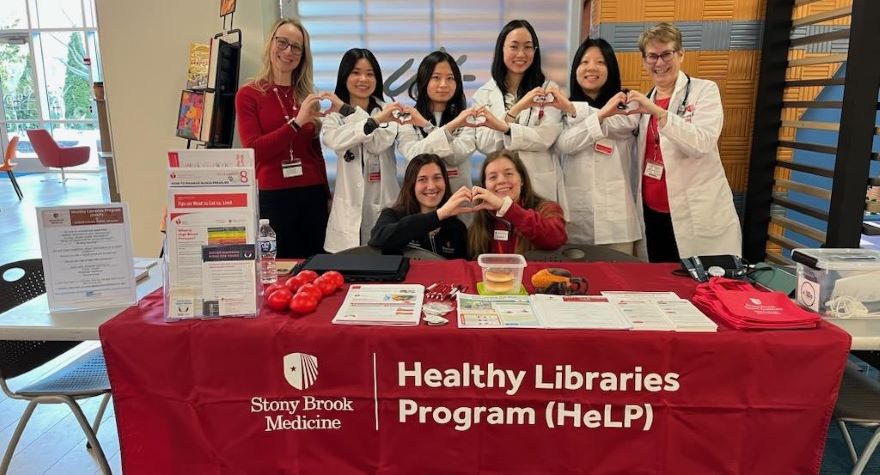
The Stony Brook Medicine Healthy Libraries Program (HeLP) launched in 2020–2021 as a partnership between:
 The Suffolk Cooperative Library System of Suffolk County
 Healthcare professionals affiliated with Health Sciences Schools and Programs (faculty, staff)
 Undergraduate and graduate students across the Health Sciences doing fieldwork, practicum, internship, or service learning

Goals of the Program
- Provide evidence-based programs that address social-behavioral determinants of health in partnership with public libraries in Suffolk County, New York.
- Connect public libraries and patrons to community resources that address health and social needs.
- Train students within their professional scope and promote interprofessional collaboration.
- Students demonstrate and apply interprofessional skills and competencies.

What We Measure
All students on teams are trained to document their interactions with patrons in real time using a secure, web-based Qualtrics data management tool. Topics documented include:
- Information provided to patrons on health and social needs
- Educational resources or services provided
- Recorded blood pressure (mmHg)
- Responses to blood pressure care/control questions
- Sociodemographic information (e.g., age, gender, ZIP code)
- Food insecurity screening (CDC Hunger Vital Signs)
- Referral plans and follow-up activities

Conception of the Program
The Program in Public Health Executive Director, Dr. Benz Scott, first heard about health programs in partnership with public libraries through a meeting with the Long Island Health Collaborative in 2016:
- Throughout 2017–2020, she conducted interviews with Public Library Staff and with Stony Brook social work students, who served as social work interns in public libraries. She identified a need for applied health and clinical knowledge to be addressed in public libraries.
- By using a group supervision model with clinical, public health, and social work students, HeLP was able to incorporate multiple student professions and expand to more library sites.
- In 2020, the program was in 5 sites. Now, the program is in over 15 library locations with student teams, and provides additional programming and services in 50 library locations.
Why Libraries?
Libraries are a trusted “go to” place for those who are in need of shelter.

- Open 5-7 days a week for all patrons
- Air conditioned/heated
- Bathrooms are available to all
- Friendly and compassionate staff
- Water fountains
- Close proximity to public transit (bus and train lines)
- Free internet access
- Free programs for enrichment, life skills, health, and healthcares
What We Achieve
The Stony Brook Medicine Healthy Libraries Program (HeLP) launched in 2020–2021 as a partnership between:
- HeLP has services in 50 public library locations in Suffolk County.
 Since 2020, over 6,000 public library patrons have received blood pressure screening and education, at no cost to the patron.
 In 2021, HeLP partnered with the American Heart Association and the Suffolk Cooperative Library System to offer self-monitoring blood pressure (SMBP) devices, available to borrow like a book, to promote care and control of high blood pressure. Devices have been borrowed to date over 4,000 times.
 Students demonstrate improvements in their competencies for interprofessional practice. Within the HeLP team, 1,000+ referrals have been made, demonstrating teams of trained students working together, under faculty supervision.
 Students have made 300+ care connections between a library patron and a healthcare provider following a HeLP interaction.
Goals for the Future
- Expand to additional public library locations, in and outside of Suffolk County.
- Strengthen program ties to health and clinical providers, to increase the number of patrons connected to care after receiving services.
- Integrate additional health-related professions in the team model to expand the scope of services delivered to patrons.
- Continue sharing HeLP through dissemination activities including semester and annual-reviewed reports, peer-reviewed publications, national conferences, and University-wide presentations.
- Network with similar programs nationally to develop resource sharing, co-learning, and build capacity to address social determinants of health in partnership with public libraries.
