

For Aaliyah Schwenderman-Randall, M.A., pursuing a PhD in Population Health at Stony Brook University is about more than advancing her research. It is about using research to better understand and address the health inequities that affect communities that have historically been overlooked.
Aaliyah, who is expected to graduate in 2030, was recently selected as a Dr. W. Burghardt Turner Fellow. The fellowship recognizes graduate students who have overcome barriers on their path to higher education and who are committed to making a difference in their communities.
“I came to Stony Brook University because I saw an opportunity to continue the kind of community-centered research I was doing in Philadelphia,” Aaliyah said.
As a Turner Fellow, Aaliyah hopes to connect with others who share her commitment to engaging communities and improving the lives of Black Long Islanders and other historically underserved communities.
Before coming to Stony Brook, Aaliyah worked as a Clinical Research Coordinator at the University of Pennsylvania’s Center for Food and Nutrition Policy, where she supported multiple NIH-funded projects focused on nutrition, economics and behavioral interventions designed to improve health among disadvantaged populations in Philadelphia.
That experience reinforced the importance of approaching health equity from multiple perspectives, including psychology, nutrition, public health and epidemiology.
“It taught me to be an adaptive researcher and reinforced for me that there is no one-size-fits-all solution to advancing health equity,” she said.
Her long-term goal is to conduct research that bridges rigorous science and community needs, with a focus on developing health interventions that can meaningfully improve outcomes for the people who need them most.
Growing up in Southeast D.C., Aaliyah witnessed disparities in the health system before she had the educational background to understand the forces behind them.
Her experiences later led her to examine the history and mechanisms of segregation and inequality and the ways that access to resources can shape opportunities from an early age.
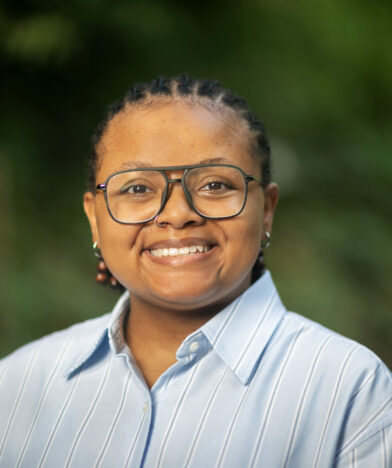
For Aaliyah, increasing representation of underrepresented groups in higher education is about more than representation. She sees it as an important part of building trust and ensuring that communities have a voice in the research and policy decisions that affect them.
Her commitment to inclusion began during her undergraduate education at Syracuse University, where she served as Vice President of Diversity and Inclusion for the National Panhellenic Council. She worked with campus offices and organizations to develop programming and educational opportunities focused on diversity and inclusion.
Those experiences shaped her approach to leadership.
“Leadership is not simply about holding a position,” Aaliyah said. “It is about listening to communities, building relationships, creating opportunities for others, and being willing to do the work needed to make those opportunities meaningful.”
Today, Aaliyah's research interests center on the structural and social determinants of health that contribute to disparities in cardiovascular disease and cancer outcomes among Black women.
She is particularly interested in disparities in breast cancer prevention, detection and mortality, as well as the intersection of cardiovascular health and cancer treatment.
Ultimately, she hopes to develop culturally responsive interventions that promote early risk detection for cardiovascular disease and reduce breast cancer mortality.
Her previous research experience has given her a strong foundation in the operational and analytical skills needed to conduct this work, while the Turner Fellowship provides an opportunity to continue developing as a researcher and connect with a community of scholars and leaders who share a commitment to improving health and well-being.
“I want my work to reflect a commitment to being inclusive and empathetic while developing health interventions that can meaningfully improve health outcomes for those who need it most,” Aaliyah said.
Through her research, Aaliyah is working toward a future where communities are not only represented in health research, but are active participants in shaping the questions being asked and the solutions being developed.
